
Why AI Sucks At Front End · 12 April 2026
AI is a sycophantic dev wannabe that skimmed a shitload of tutorials. You get the results of a probabilistic guess based on patterns it saw during training. What did it train on? Ancient solutions, unoriginal UI patterns, and watered down junk.
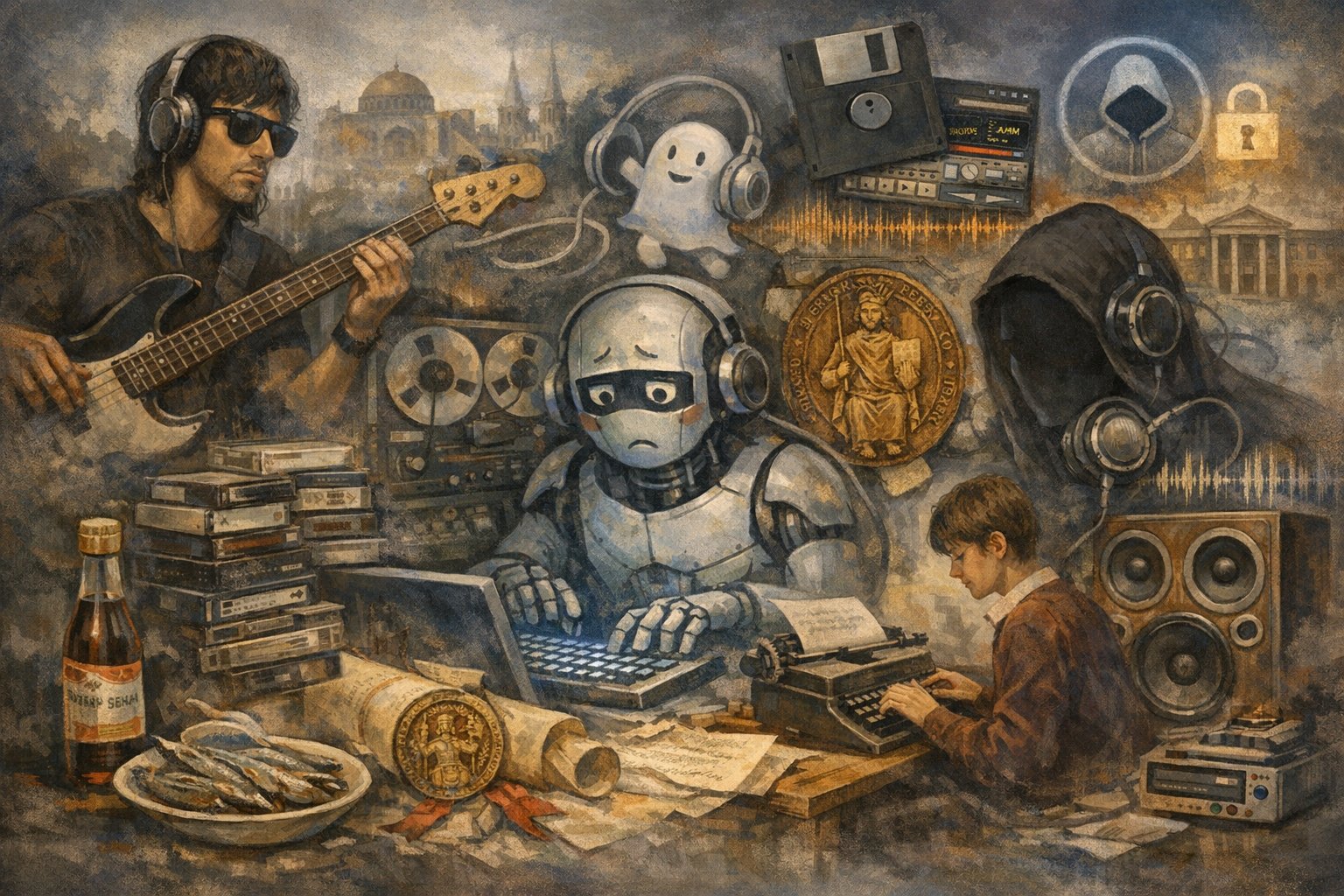
How This Bass Riff Completely BROKE the Internet.
Davie504 en Angine de Poitrine. Beter wordt het niet.
Thousands of rare concert recordings are landing on the Internet Archive — listen now | TechCrunch
Chicago-based music superfan Aadam Jacobs has been recording the concerts he attends since the 1980s, amassing an archive of over 10,000 tapes. Now 59, Jacobs knows that these cassettes are going to degrade over time, so he agreed to let volunteers from the Internet Archive, the nonprofit digital library, digitize the tapes.
Lost for 40 Years, Royal Seal of Edward the Confessor Found in Paris — Reveals Unexpected Byzantine Link | Ancientist
A rare royal seal belonging to Edward the Confessor, the last Anglo-Saxon king of England, has now resurfaced in Paris after more than 40 years. This development is not simply the recovery of a lost artifact; it offers an unexpected window into the political vision of pre-Norman England.
Direct Win32 API, Weird-Shaped Windows, and Why They Mostly Disappeared
There was a period when Windows apps were allowed to look strange. Media players looked like hardware. Desktop mascots walked around your screen. Utility panels looked like dashboards, toys, radios, or little alien control consoles. A window did not have to be a rectangle just because the operating system started you with one.
SPEAKE(a)R: Turn Speakers to Microphones for Fun and Profit
It's possible to manipulate the headphones, earphones, and simple earbuds connected to a computer, silently turning them into a pair of eavesdropping microphones. This paper focuses on the cyber security threat this behavior poses. We introduce 'SPEAKE(a)R,' a new type of espionage malware that can covertly turn the headphones, earphones, or simple earbuds connected to a PC into microphones when a standard microphone is not present, muted, taped, or turned off.
A college instructor turns to typewriters to curb AI-written work and teach life lessons – Sentinel Colorado
The scene is right out of the 1950s with students pecking away at manual typewriters, the machines dinging at the end of each line. Once each semester, Grit Matthias Phelps, a German language instructor at Cornell University, introduces her students to the raw feeling of typing without online assistance. No screens, online dictionaries, spellcheckers or delete keys. The exercise started in spring 2023 as Phelps grew frustrated with the reality that students were using generative AI and online translation platforms to churn out grammatically perfect assignments.
Ole Lehmann on X: "anthropic's in-house philosopher thinks claude gets anxious. and when you trigger its anxiety, your outputs get worse. her name is amanda askell. she specializes in claude's psychology (how the model behaves, how it thinks about its own situation, what values it holds) in a https://t.co/9Sm0Iw9t9a" / X
Tone, trust, permission to take a position, the absence of threats… Claude picks up on all of it. So take care of the model, and it'll take care of the work.
A Brief History of Fish Sauce
As Grainger explains in her book, liquamen is the standard fish sauce, made by dissolving whole small fish, often anchovies, layered with salt in a barrel or pit and left to ferment for up to four months. In contrast, garum (proper garum, not the garum that’s used interchangeably to describe ‘ancient’ fish sauce) is thicker and darker, and made from fermented fish blood and viscera. It has a distinctively dark colour and iron-rich taste. The Romans actually had a whole vocabulary for fermented fish products: garum, liquamen, allec, and muria each described distinct preparations. When we compare ancient Roman fish sauce to modern nuoc mam or nam pla, we are really talking about liquamen and not garum.
I can never talk to an AI anonymously again
But soon, the entire debate over internet anonymity will be as anachronistic as an iPod Touch. That’s because Claude Opus 4.7 is here, and last week, I discovered it could identify me from text I had never published, text from when I was in high school, text from genres I have never publicly written in. And if it can identify me, soon, it will be able to identify many of you.