
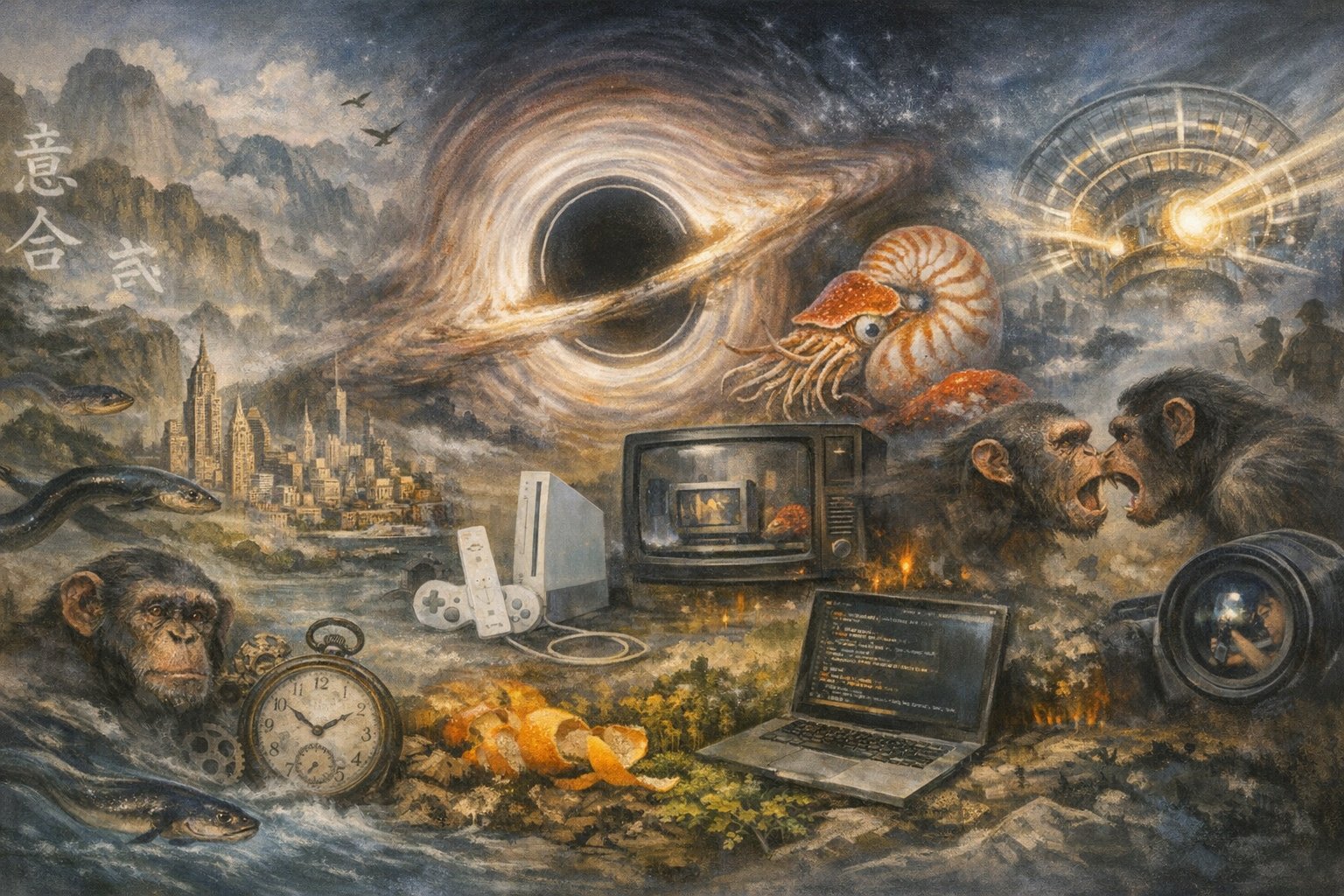
Why Modern Chinese is Just ‘English with Hanzi’ – by JingYu
Looking at the fundamental architecture of language. Traditional Chinese is a language of parataxis (意合, idea-joining). It is like a traditional landscape painting; elements are placed side by side, and the relationship between them is inferred by context, intuition, and white space. There are few connectors, no strict tenses, and subject-verb agreements are loose. English, and other Indo-European languages, are languages of hypotaxis (形合, form-joining). They are architectural blueprints. They require conjunctions, prepositions, relative clauses, and tense markers to lock every piece of information into a precise, unshakeable hierarchy. Over the last hundred years, Chinese has moved from the fluid landscape painting to the rigid blueprint. The Indo-European grammar have been imported and forced into the fluid body of Hanzi.
Scientists Finally Figured Out How Eels Reproduce
After decades of speculation, researchers have successfully tracked European eels back to their breeding grounds in the Sargasso Sea, following their journeys thousands of kilometers along one of nature’s most incredible animal migrations. Scientists are ecstatic because this is the first confirmation of a long-suspected stage of the eels’ life cycle, which was proposed about 100 years ago. Fish biologist Kim Aarestrup from the Technical University of Denmark, the study’s author, stated on Twitter that “eels have piqued the curiosity of scientists for millennia.” North Atlantic Ocean’s Sargasso Sea is where eels congregate to breed, yet until recently, no eels or eggs have been discovered. “For the first time, we followed eels to their spawning grounds,” added Aarestrup.
The Last Quiet Thing | Terry Godier
One of these is a product. The other is a relationship. Your thermostat has opinions now. Your television requires a login. Your car updates itself overnight, and sometimes when you start it in the morning, the interface has rearranged itself, as if someone broke in and reorganized your dashboard while you slept.
The secrets of black holes and the Higgs mass could be hidden in a 7-dimensional geometry
One of the greatest mysteries of modern physics, the "black hole information paradox," might have finally found an elegant solution, and the answer could also reveal the origins of the mass of fundamental particles.
How 12,000 Tonnes of Dumped Orange Peel Grew Into a Landscape Nobody Expected to Find : ScienceAlert
An experimental conservation project that was abandoned and almost forgotten about, has ended up producing an amazing ecological win nearly two decades after it was dreamt up. The plan, which saw a juice company dump 1,000 truckloads of waste orange peel in a barren pasture in Costa Rica back in the mid 1990s, has eventually revitalised the desolate site into a thriving, lush forest.
The Git Commands I Run Before Reading Any Code
Five git commands that tell you where a codebase hurts before you open a single file. Churn hotspots, bus factor, bug clusters, and crisis patterns.
A Truck Driver Spent 20 Years Making This Astonishing Scale Model of Every Single Building in New York City
The 1,350-square-foot model is now on display at the Museum of the City of New York, where visitors can use binoculars to see tiny replicas of all five boroughs
Porting Mac OS X to the Nintendo Wii | Bryan Keller’s Dev Blog
Since its launch in 2007, the Wii has seen several operating systems ported to it: Linux, NetBSD, and most-recently, Windows NT. Today, Mac OS X joins that list. In this post, I’ll share how I ported the first version of Mac OS X, 10.0 Cheetah, to the Nintendo Wii.
Chimpanzees in Uganda locked in vicious 'civil war', say researchers
The world's largest known group of wild chimpanzees has split and been locked in a vicious "civil war" for the last eight years, according to researchers. It is not clear exactly why the once close-knit community of Ngogo chimpanzees at Uganda's Kibale National Park are at loggerheads, but since 2018 the scientists have recorded 24 killings, including 17 infants.
300-million-year-old sea creature loses title as world's oldest octopus | AP News
To solve the mystery of the “weird blob,” Clements and his team used a synchrotron — which uses fast-moving electrons to create beams of light brighter than the sun — to look inside the fossil rock. They found a ribbon of teeth known as a radula that is common to all mollusks, including nautiluses and octopuses. Each row had 11 teeth. Octopuses have either seven or nine. “This has too many teeth, so it can’t be an octopus,” Clements said. “And that’s how we realize that the world’s oldest octopus is actually a fossil nautilus, not an octopus.”
They See Your Photos
Your photos reveal a lot of private information. In this experiment, we use the Google Vision API to see how much can be inferred about you from a single photo. See what they see.